Functional safety
FACHMANN/Solutions/Functional safety

Protect the operator
without slowing production.

ISO 13849-1 · up to PLeIEC 62061 · up to SIL 3ISO 14119

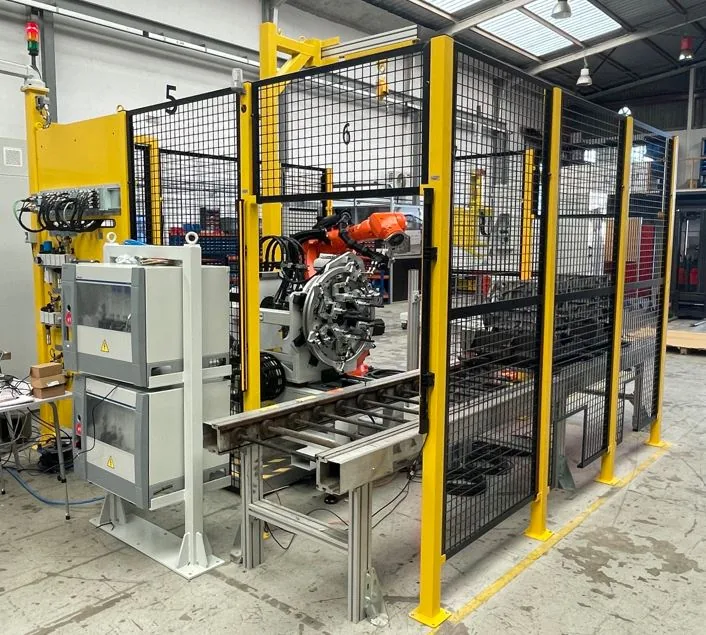
We design the safety of each machine end to end, from the sensor that detects the hazard to the stop that removes it, without guards that end up open or stops that halt the line for no reason. We start from the risk assessment and reach up to PLe per ISO 13849-1 and SIL 3 per IEC 62061.

Why it matters

The component is PLe.
The function isn't.

Cuando la seguridad de una máquina falla, la consecuencia es un accidente, una máquina clausurada y una responsabilidad legal que recae sobre la empresa y sobre quien firmó la instalación. El error que más vemos en planta es creer que comprar componentes certificados alcanza. El nivel de seguridad lo da la cadena completa: un contactor sin monitoreo, un interruptor que se puentea con un actuador de repuesto o un rearme ubicado donde no se ve el riesgo bajan la función real muy por debajo de lo que dice el papel. La máquina “cumple” hasta el día del accidente.

How we approach it

We start from the risk, not from the catalogue.

01 /

Assessment

We assess the machine per ISO 12100.

02 /

Required level

We define the PL or SIL each function requires.

03 /

Technology

Logic, detection and control with our partners' technology.

Related solutions

01

Emergency stop

It is the last line of defence: it does not replace a guard, but it must be within reach the moment something goes wrong. On a compact machine, well-placed push buttons are enough; on a conveyor hundreds of metres long you need a rope that can be pulled from any point. What decides is the operator's distance to the hazard and that the stop stays latched until a manual reset.

With
PILZIDEM SAFETY
Key standard
ISO 13850
02

Guard interlocking and locking

A movable guard only protects if the machine knows it is open. If the hazardous part stops before someone can reach it, interlocking the door is enough; if it keeps running down by inertia, the door must stay locked until it stops. The selection criteria are stopping time versus access time, the coding level so it cannot be defeated, and the environment: vibration, washdown or dust.

With
PILZIDEM SAFETY
Key standard
ISO 14119
03

Presence detection

When the operator enters many times per shift, a guard with a door slows production and ends up open. Non-contact detection protects without getting in the way: a barrier at the loading opening, a scanner watching the floor of a cell, or a radar where dust, steam or sparks blind an optical sensor. The safety distance is non-negotiable: the sensor must detect the person early enough for the machine to stop before they reach it.

With
PILZ
Key standards
IEC 61496ISO 13855
04

Safety logic and control

This is where the decision is made whether the machine keeps running or stops. It receives dual-channel signals, detects wiring and device faults, and enables reset only when it is safe. For a few functions, fixed logic is enough; when there are many doors, zones and operating modes, a configurable controller that also tells the line PLC what tripped and where is the better choice.

With
PILZIDEM SAFETY
Key standard
ISO 13849-1
05

Machine access management

Some tasks require entering the machine: changing a die, teaching a robot, cleaning or clearing a jam. The risk is someone energising it while a person is inside. It is solved with key-based access sequences that do not depend on electronics, enabling devices for working in service mode, and controls that require both hands outside the danger zone.

With
PILZIDEM SAFETY
Key standards
ISO/TS 19837IEC 60947-5-8

Referenced standards

ISO 13849-1
Safety-related parts of control systems: Performance Level (PL).
IEC 62061
Functional safety of machine control systems: Safety Integrity Level (SIL).
ISO 12100
Safety of machinery: general principles for design and risk assessment.
ISO 14119
Interlocking devices associated with guards: design and selection.
ISO 13850
Emergency stop function: principles for design.
IEC 61496
Electro-sensitive protective equipment: light curtains, scanners and presence sensors.
ISO 13855
Positioning of safeguards with respect to approach speeds.
ISO/TS 19837
Trapped key interlocking systems: design and selection.
IEC 60947-5-8
Three-position enabling switches.

Tell us your application.

We help you size the right solution for your plant.

  • A team of experts handles your case
  • We assess the risk and the application before recommending
  • You get the right solution
Step 01 / 05

Let's start with the application

Which machine, process or installation do you need to solve? Five questions, no more.

Begin survey