Lightning & surge protection
FACHMANN/Solutions/Lightning & surge

Conducting lightning to earth
without harm to people or equipment.

IEC 62305 · lightningIEC 61643-11 · Type 1 to 3IEC 62561-1 · components

We design complete protection against lightning and surges: from air termination on the structure to the surge arrester next to each sensitive device. Up to 100 kA lightning current (10/350 µs) at the service entrance, photovoltaic installations up to 1500 V DC and certified solutions for hazardous areas.

Why it matters

A single surge arrester
is not a protection system.

Lightning current seeks the lowest-impedance path to earth. If the installation does not provide one, it finds it through structures, cables and equipment. Surges also enter through the power supply and signal lines, and originate from switching operations within the plant itself. The consequences are destroyed equipment such as inverters, controllers and UPS units, fires, extended downtime and, in hazardous areas, ignition risk. The most common deviations are a Type 2 arrester installed where Type 1 is required, arresters out of service that nobody monitors, and earthing whose resistance no longer meets the design.

How we approach it

We start from the risk assessment, which defines the protection level.

01 /

Risk assessment

Required protection level per IEC 62305-2 and IRAM 2184.

02 /

Protection zones

Air termination, down conductors to earth, equipotential bonding and surge and lightning protection.

03 /

Technology

We integrate the right technology from our partners for each zone.

Related solutions

01

External lightning protection

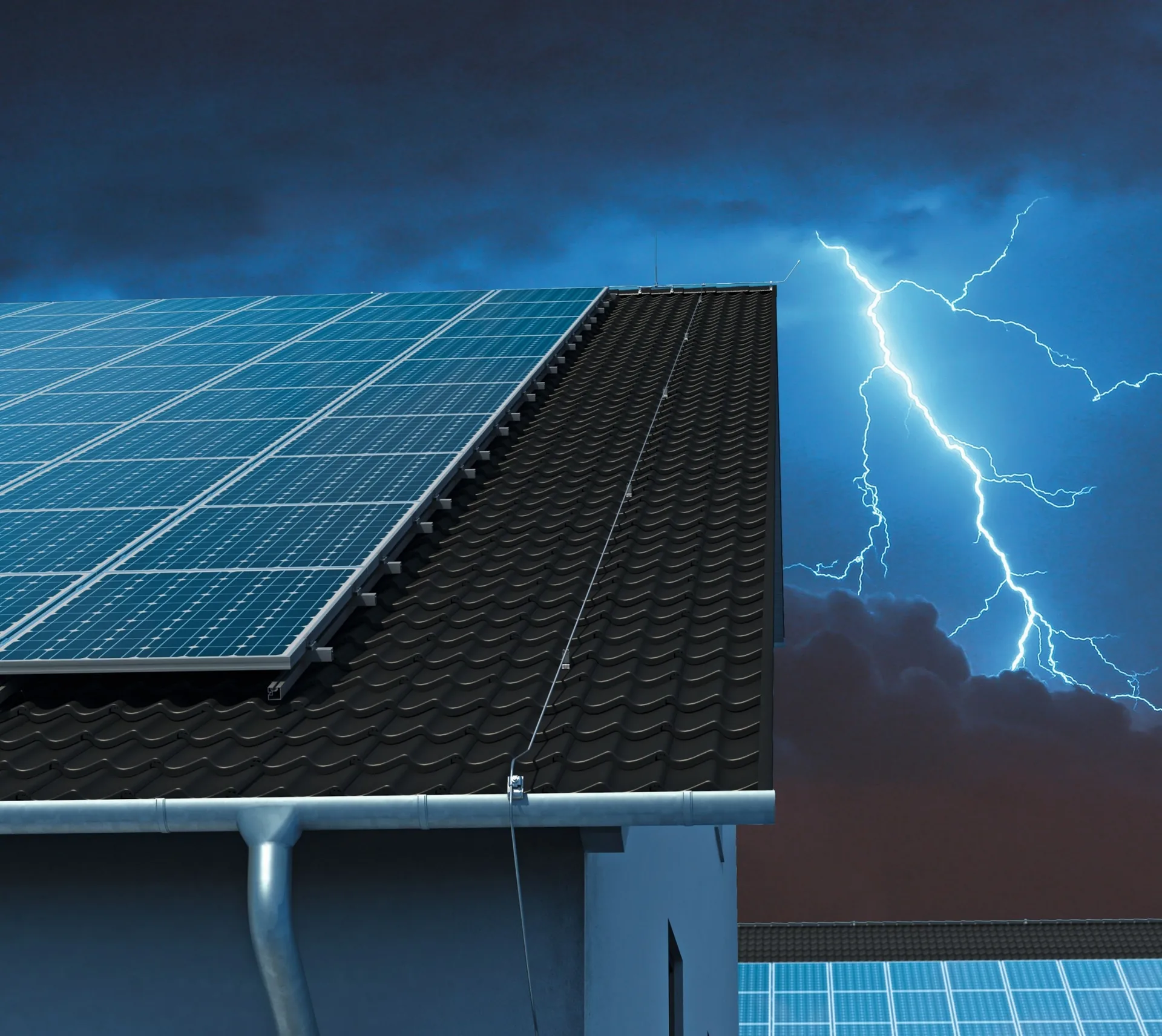
Intercepts the strike before it hits the structure or rooftop equipment and conducts it to earth along a defined path. The critical condition is maintaining the separation distance between the protection system and the building's metallic or electrical parts; where space does not allow it, high-voltage-resistant insulated conductors achieve the same in a few centimeters.

With
OBO BETTERMANN
Key standard
IEC 62305-3
02

Earthing and equipotential bonding

The final destination of lightning current and the reference for the whole installation. Low-resistance, corrosion-resistant earthing, combined with bonding of all metallic parts through busbars and connectors tested with lightning current, prevents dangerous potential differences between structures, piping and equipment.

With
OBO BETTERMANN
Key standard
IEC 62561-2
03

Surge protection

Surges are controlled in stages: a Type 1+2 arrester at the service entrance diverts lightning current, a Type 2 in distribution panels limits transients and a Type 3 protects the sensitive device. The three stages must be coordinated. Versions with remote signaling allow their status to be monitored from the management system and a module to be replaced before the installation is left unprotected.

With
OBO BETTERMANNCABUR
Key standard
IEC 61643-11
04

Surges in photovoltaic installations

A photovoltaic installation combines a large exposed area, long cable runs and a DC side that requires dedicated arresters. Protection is installed at the inverter inputs and outputs, on both the DC and AC sides, and sized so that the array's maximum open-circuit voltage does not exceed the arrester's operating voltage.

With
OBO BETTERMANNCABUR
Key standard
IEC 61643-31
05

Protection in Ex zones

In hazardous areas, any component of the protection system can be an ignition source. Ex-rated insulated conductors, certified components and arresters dedicated to intrinsically safe instrumentation loops are required, installed at both ends of the loop to protect the interface and the field instrument.

With
OBO BETTERMANNGMI
Key standard
IEC 60079-14
06

Cathodic protection

Pipelines, tanks and buried structures with cathodic protection are divided into electrically isolated sections by insulating flanges and threaded joints. During a strike, the potential difference between both sides can cause an uncontrolled arc, often inside a hazardous area; bonding the sections with a conductor, however, would cancel the protection. Isolating spark gaps resolve this conflict: they keep the sections isolated in normal operation and connect them in a controlled way during the discharge. They are also used to link earthing systems that must remain separate, with versions certified for zones 1, 2, 21 and 22. Buried joints are completed with anti-corrosion tapes.

With
OBO BETTERMANN
Key standard
IEC 62561-3

Referenced standards

IEC 62305
Lightning protection, parts 1 to 4.
IEC 62305-2
Lightning protection: risk management.
IEC 62305-3
Lightning protection: physical damage to structures and life hazard.
IEC 62561-1
Lightning protection system components: connection components.
IEC 62561-2
Lightning protection system components: conductors and earth electrodes.
IEC 62561-3
Lightning protection system components: isolating spark gaps.
IEC 61643-11
Low-voltage surge protective devices: requirements and tests (Type 1, 2 and 3).
IEC 61643-31
Surge protective devices for the DC side of photovoltaic installations.
IEC 60079-14
Design, selection and erection of electrical installations in explosive atmospheres.
IRAM 2184
Argentine standard for protection of structures against lightning.

Tell us your application.

We help you size the right solution for your plant.

  • A team of experts handles your case
  • We assess the risk and the application before recommending
  • You get the right solution
Step 01 / 05

Let's start with the application

Which machine, process or installation do you need to solve? Five questions, no more.

Begin survey